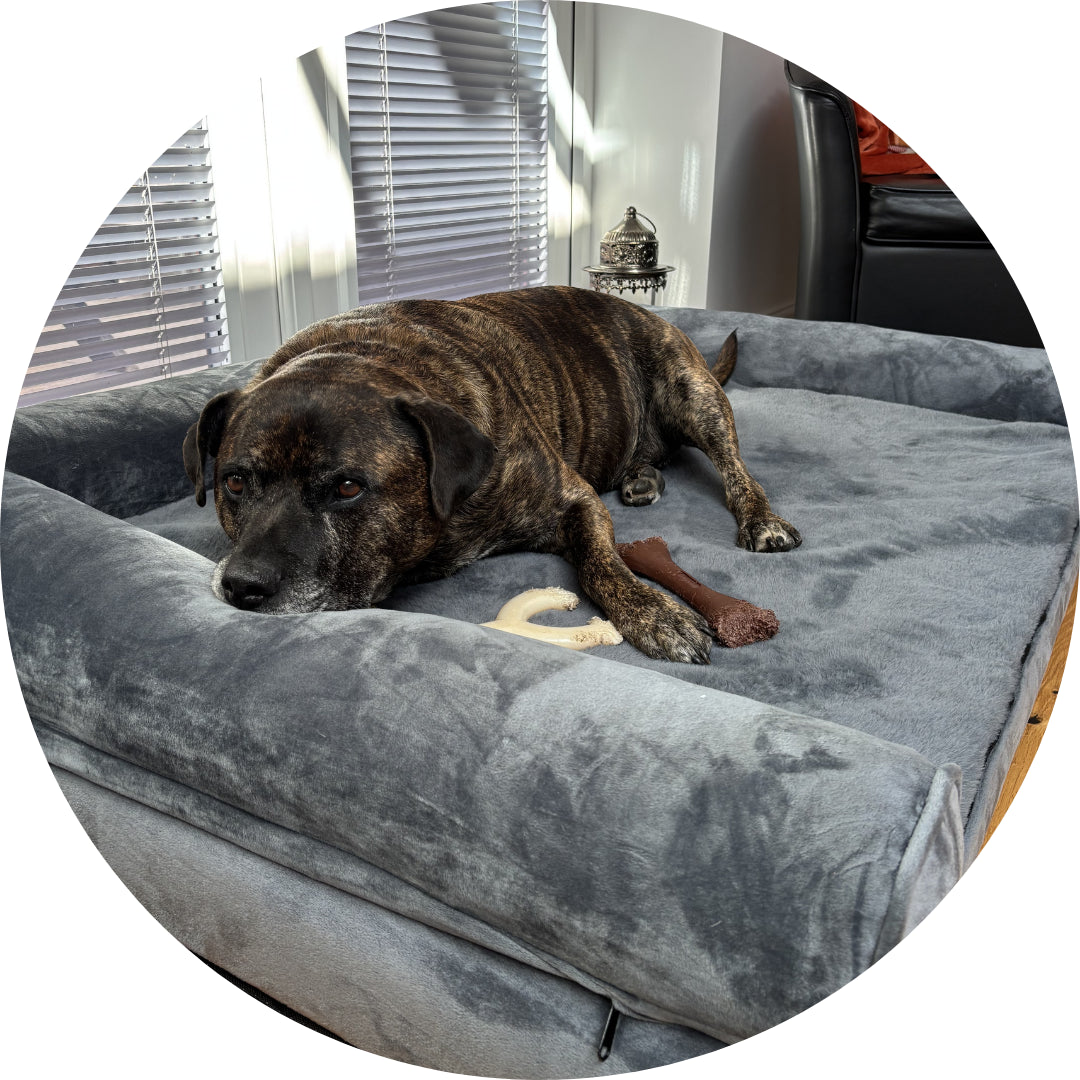

I spent a year simmering bone broth for my old boy. Then I found out the heat was undoing the one thing I was making it for.
How Eivor's slow mornings led me to a tiny, clinically studied form of collagen, and why I turned it into a soft chew an old dog will actually eat.

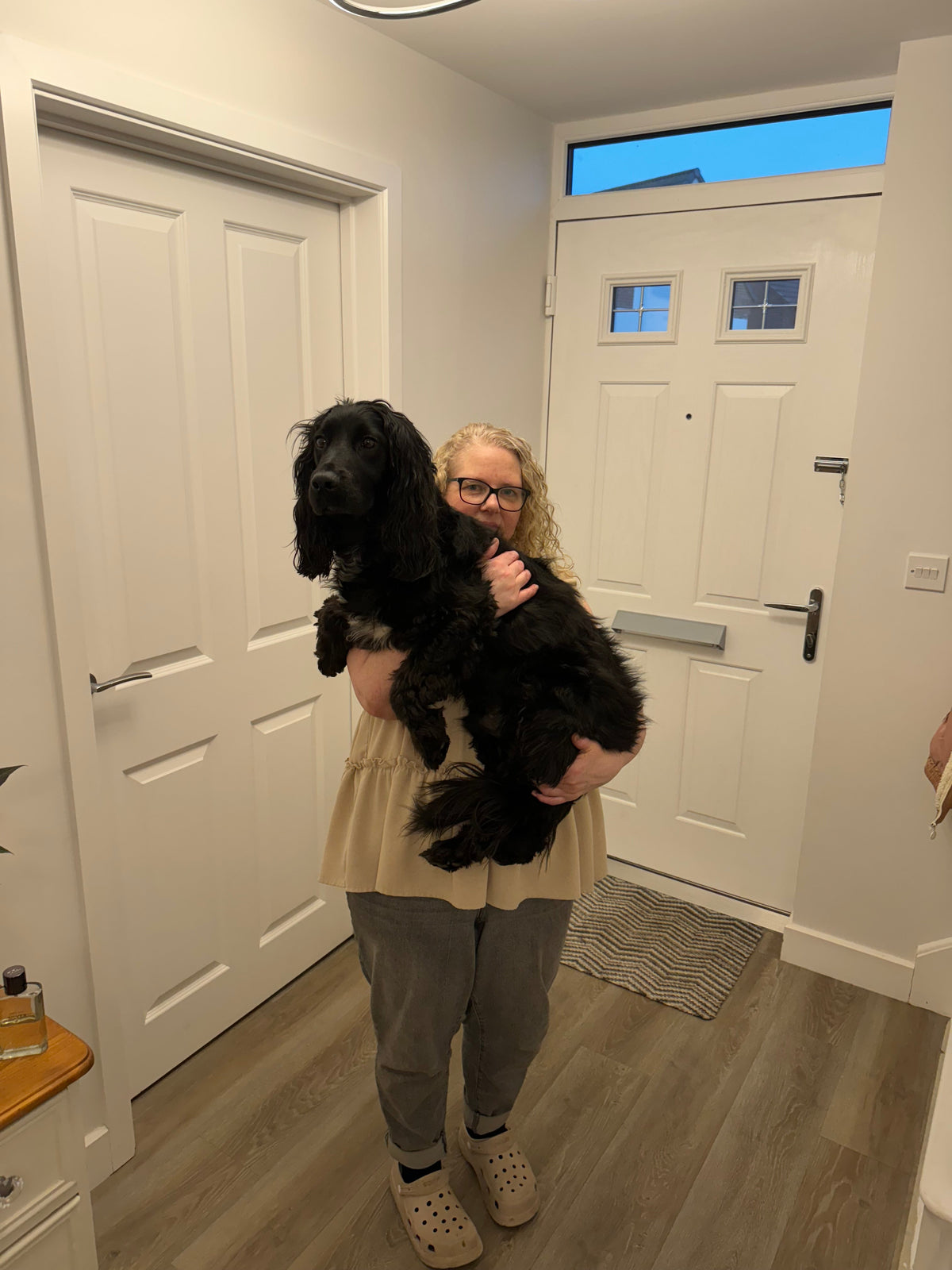
It started with five steps.
Every morning, Eivor would get up from his bed by the radiator.
And for the first five steps, he looked like a different dog.
Stiff. Careful. Back legs a beat behind the front.
Then he'd get going, and by the time the kettle had boiled, he was fine.
So I told myself he was fine.
He was eight. He was a cocker spaniel. Dogs slow down as they get older. Everyone says so.
"He's just getting on a bit," I'd say to anyone who asked.
But I kept watching those five steps.
And they kept getting slower.
Then it wasn't just the mornings
The car was next.
All his life, the second I opened the boot at the playing field, Eivor would fly out of it.
Now he'd stand at the edge and look down.
Look at me.
Look back down at the ground.
Some days he'd go for it and land heavily. Some days I'd end up lifting him down myself.
Then the walks.
Our loop round the local playing field used to never be enough for him.
Now he'd stop halfway round and look back towards the car.
I started cutting it short "because it was cold".
It wasn't the cold.
And then the stairs.
Eivor had slept on the landing outside our bedroom door since he was a puppy.
One night, he stood at the bottom of the stairs, looked up, and lay down.
I sat on the bottom step with him for a long time that night.
Nobody tells you that's how it happens. Not with a limp. Not with a big moment. With small things.
A bit slower. Some days. Only minor.
Until you add them up and realise the dog in front of you isn't quite the dog you remember.
The worst part?
He still wanted to do everything.
His head still shot up when I picked up the lead.
His brain still said go. His back legs said hang on.
And I would have done anything to close that gap for him.
So I did what everyone does
I bought the joint supplement from the pet shop. The big brand, with the happy dog on the box.
Then a different one. Then fish oil. Then turmeric stirred into his dinner.
I'm going to be honest with you, because I wish someone had been honest with me.
I couldn't tell if any of it was doing anything.
He had good days and bad days.
On a good day, I'd think: it's working.
On a bad day, I'd think: waste of money.
And I'd second-guess myself all over again.
The chews were the worst.
This is a dog who once ate a dirty sock I'd worn all day in my sweaty work boots.
He'd sniff the joint chew, look at me like I'd insulted him, and walk off.
I hid them in cheese. In ham. In peanut butter.
He ate around them every single time.
So I gave up on the shop-bought stuff and went looking for something "real".
Something I could make myself, in my own kitchen, and know exactly what was in it.
That's how I found bone broth.
The bone broth months
Every forum I read said the same thing.
Bone broth. It's full of collagen. And collagen is what cartilage is made of.
It made perfect sense to me. Give him the building blocks, right?
So every Sunday, I filled my biggest pot with chicken feet, knuckle bones and a splash of cider vinegar.
I simmered it for 24 hours. The whole house smelled of it.
I skimmed it, strained it, cooled it, and poured it into ice cube trays.
One cube on his breakfast. Every day.

He loved it. He'd sit by the fridge waiting for it.
And I loved making it. It felt like I was finally doing something.
But after a year, I had to be honest with myself.
His mornings were no different.
Those first five steps were still stiff. Getting out of the car was still a leap of faith.
So I went looking for why.
And what I found changed how I thought about all of it.
Why my broth was never going to do what I hoped
The cartilage in a dog's joints is made mostly of one particular protein: type II collagen.
So far, so good. The chicken cartilage I was boiling is full of it.
But type II collagen in its natural state has a very specific shape.
Three protein strands, wound together in a tight spiral called a triple helix.
And on the surface of that spiral are tiny, specific patterns that scientists call epitopes.
Think of them as a fingerprint.
When you simmer collagen for hours, the heat unwinds that spiral.
The strands come apart. The fingerprint is wiped clean.
What's left is gelatin. That's why my broth set like jelly in the fridge.
Gelatin isn't bad. It's food. It gets digested into amino acids, just like the chicken in his bowl.
But the research I'd stumbled across wasn't about feeding dogs more protein.
It was about something completely different.
It was about collagen that had never been cooked. Collagen with its fingerprint still intact.
Scientists call it undenatured type II collagen.
And it doesn't work by being used as building material at all.
It works by talking to the immune system.
How undenatured type II collagen works
(The part that made me sit up.)
This is the bit I had to read three times. Stay with me, because it's the whole reason OrthoPup exists.
Your dog's immune system is on patrol every second of every day.
Its job is to tell the difference between "me" and "not me".
Most of the time, it gets that right.
But in an older dog's joints, things can get muddled.
Years of everyday wear can expose bits of type II collagen that are normally tucked away inside the cartilage.
Researchers think the immune system can start to react to those bits as if they were "not me".
And an immune system that keeps reacting inside a joint isn't a calm place for cartilage to be.
Here's where it gets clever.
Your dog's gut has its own immune training centres.
They're small clusters of immune tissue in the wall of the small intestine, called Peyer's patches.
Their job is to sample everything that comes through in food and decide: friend, or threat?
It's the reason your dog doesn't mount an immune attack every time they eat chicken.
Scientists call this process oral tolerance.
When undenatured type II collagen reaches the Peyer's patches with its fingerprint intact, the immune cells there recognise the pattern.
And instead of raising the alarm, they do the opposite.
They help produce a special kind of immune cell called a regulatory T cell.
Think of regulatory T cells as peacekeepers.
And these particular peacekeepers have been trained on one thing: type II collagen.
They travel out through the body. When they meet type II collagen in the joints, they release calming messenger proteins with names like IL-10 and TGF-beta.
Those messengers help tell the local immune response to stand down.
Sends protein to digest
- Simmered for hours
- Heat unwinds the triple helix
- Fingerprint wiped clean: it's now gelatin
- Digested into amino acids, like any food
Sends the immune system a message
- Made without long, high heat
- Fingerprint stays intact
- Recognised in the gut's Peyer's patches
- Trains "peacekeeper" T cells for the joints
Bone broth sends the joint protein to digest.
Undenatured type II collagen sends the immune system a message.
And that's why the fingerprint matters so much.
No fingerprint, no recognition. No recognition, no message.
Here's the part that surprised me most. The amount needed is tiny.
The dog studies used just 10 milligrams of active undenatured collagen a day. That's less than half the weight of a single grain of rice.
You're not feeding the joint. You're showing the immune system a fingerprint.
So this isn't about shovelling in as much as possible. What matters is the form, the amount, and that it's made without the heat that wipes the fingerprint clean.
Which is exactly why my 24-hour broth, made with all the love in the world, was never going to do it.
What the studies on dogs actually found
I wasn't going to take a supplement company's word for any of this. I'd been burned before.
So I sat at the kitchen table with a pot of tea and read the studies myself.
Here's what I found. The good bits, and the limits.
Researchers gave 15 dogs either nothing, 1 mg or 10 mg of undenatured type II collagen every day for 90 days.
The dogs on undenatured collagen scored better for comfort and movement, and they became more active. The 10 mg dogs improved the most.
Then came the part that stuck with me. The researchers stopped giving it for 30 days. And every dog slipped back.
Whatever was happening, it was happening while they were taking it. Not before, and not after they stopped.
At the University of Bari in Italy, 30 dogs were given one undenatured type II collagen tablet a day for 30 days.
Their owner-reported mobility scores improved by about a third.
Now, the honest bit, because you deserve it.
These are small studies. Several were run with the people who make the ingredient. The 2019 study had no placebo group, so it can't rule out owners expecting to see a change. And the dogs in them had been diagnosed by a vet, not just slowing down a bit.
That's not a reason to ignore the research. It's a reason not to believe anyone who calls this a miracle. Including me.
But after years of buying things based on a happy dog on a box, it was the first time I'd found a reason. An actual mechanism. Studied in actual dogs.
And it explained why the broth hadn't worked.
So I made the thing I couldn't find
I went looking for a product with undenatured type II collagen that Eivor would actually eat.
The ones I found were tablets he'd spit out, or chews packed with so many other ingredients I couldn't tell how much of the important one was in there.
So I started working on my own.
It took three years and more samples than I'd like to admit.
I had three rules.
He has to want it.
If an old dog won't eat it, nothing else matters.
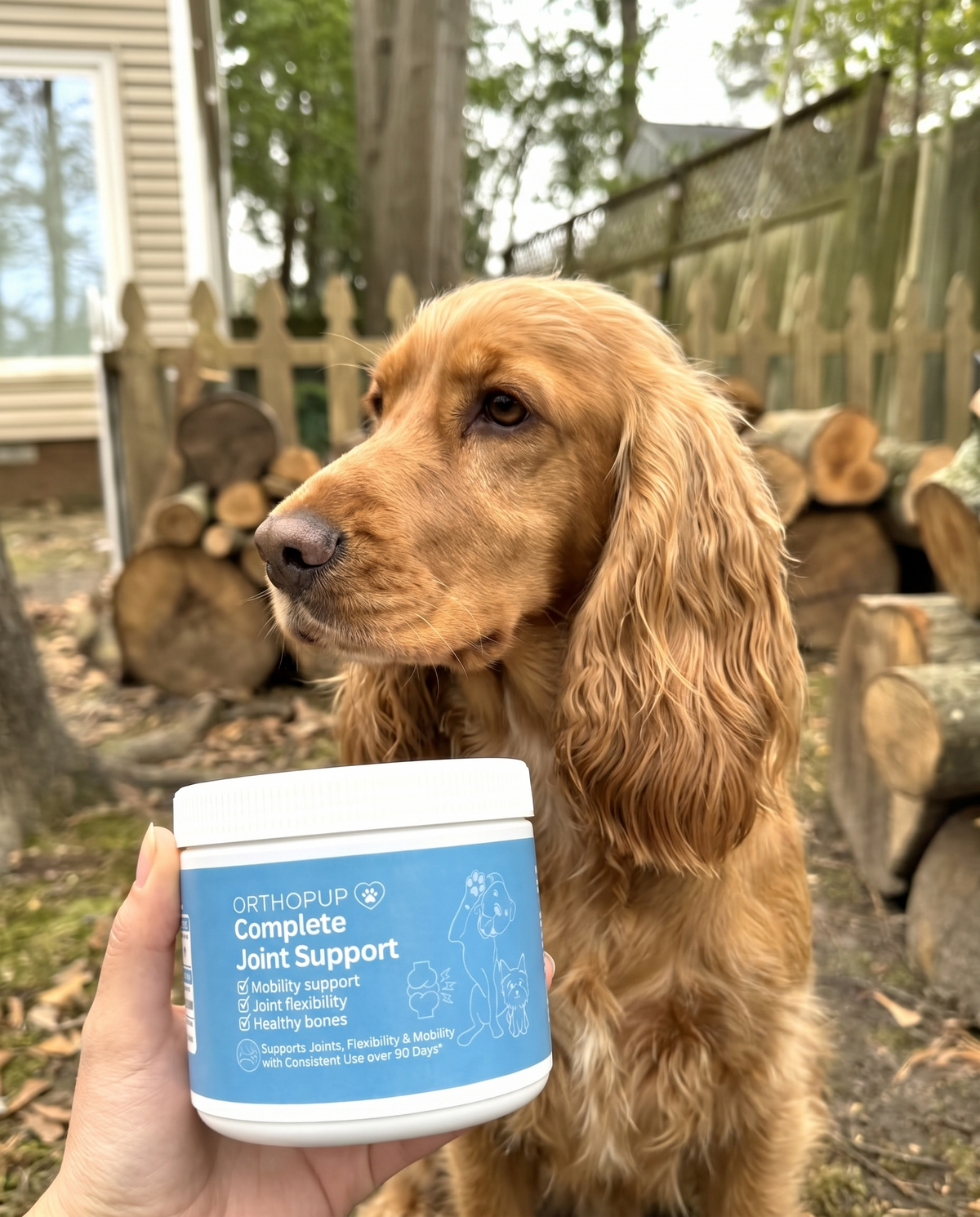
So OrthoPup is a soft chew, made for older mouths and older teeth, in chicken and beef flavour.
We tested every version on the fussiest dogs we could find. Including the one who'll eat a sock but draws the line at joint chews.
The right form, in an amount you can see.
Every OrthoPup chew contains 100 mg of undenatured type II collagen, and bigger dogs get more chews a day.
It's made without the long, high heat that wipes the fingerprint clean.
And the amount is printed on the pack, so you never have to guess.
You have to be able to see it for yourself.
This is the one nobody else was doing.
After years of "good days and bad days", I didn't want another product I had to take on faith.
So every OrthoPup box comes with a simple 90-day tracker.
Five everyday moments: the first steps out of bed, the car, the stairs, the sofa, and the walk.
You score each one once a week. It takes about a minute.
| Moment | Wk 1 | Wk 4 | Wk 8 | Wk 12 |
|---|---|---|---|---|
| First steps out of bed | 2 | 3 | 4 | 4 |
| The car | 1 | 2 | 3 | 4 |
| The stairs | 2 | 2 | 3 | 4 |
| The sofa | 3 | 3 | 4 | 4 |
| The walk | 2 | 3 | 3 | 4 |
By the end, you're not guessing. You've got your own record, from your own dog.
And if you want to, you can take it to your next vet check-up.
What I won't promise you
I'm not going to tell you OrthoPup will make your dog a puppy again.
It won't stop them getting older. Nothing will.
And if anyone tells you otherwise, I'd keep your hand on your wallet.
Here's what I will tell you.
Eivor is still an old boy. He still naps most of the afternoon.
But these days, he takes the stairs at bedtime without stopping at the bottom first.
And when I open the boot at the playing field, that long pause at the edge has gone. He just jumps.
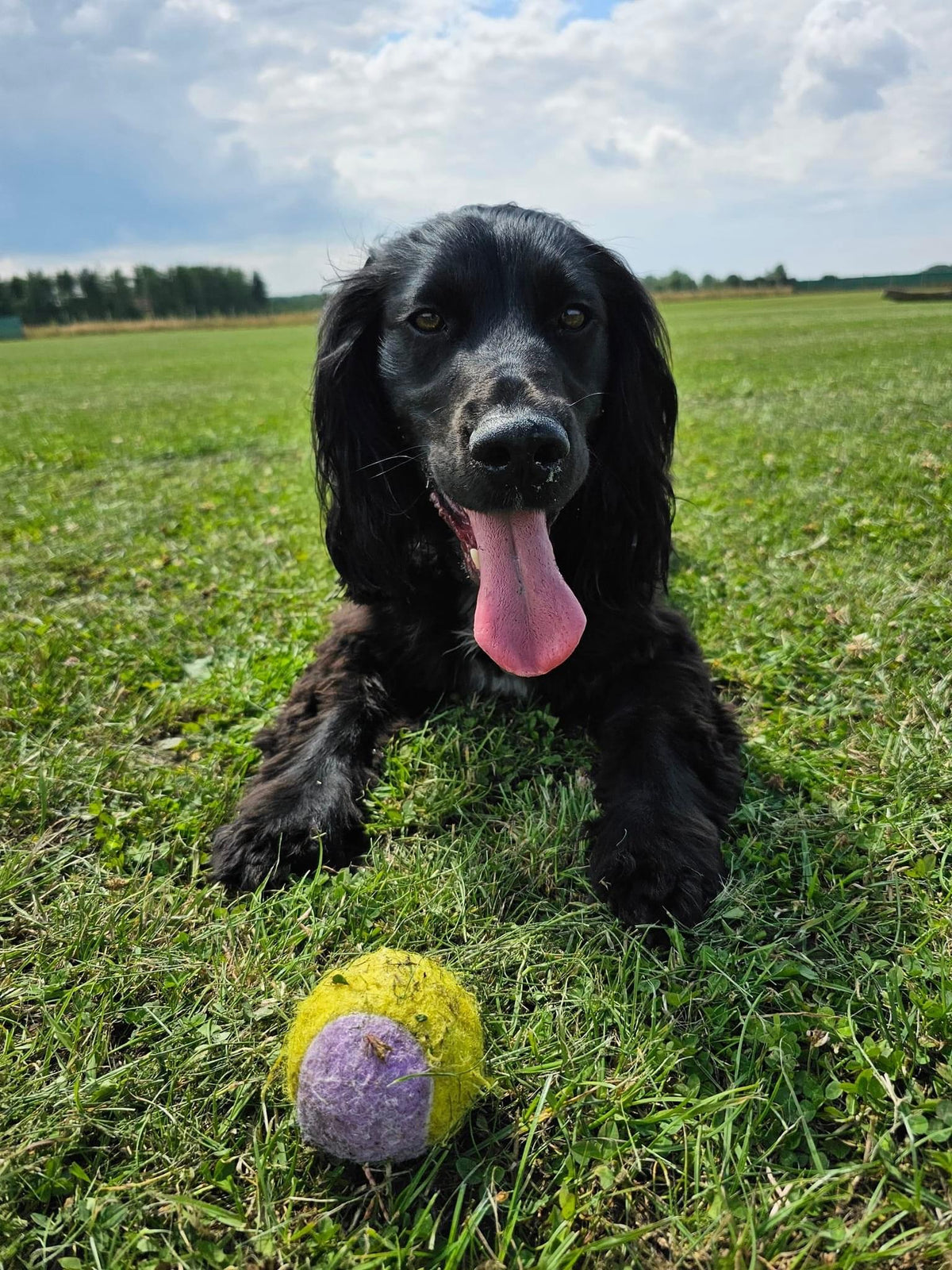
That's it. That's the whole dream. Not a new dog. Just more of the ordinary days, together.
How to know if it's right for your dog
OrthoPup is for you if:
- Your dog is stiff for a while after resting, then "fine once they get going".
- Getting in or out of the car, the stairs or the sofa have started to need a bit of thought.
- The walks are getting shorter, and you know it isn't the weather.
- You've tried a joint supplement before and honestly couldn't tell if it did anything.
If your dog's changed suddenly, is limping, or you're worried about pain, please see your vet first. OrthoPup isn't a medicine and it isn't a replacement for one.
Give it 8 weeks. Track it for 12.
The immune system doesn't change overnight.
Most owners who notice a difference talk about it somewhere between two and eight weeks in. Some take longer.
And remember the 2005 study: the difference showed while the dogs were taking it, and faded when they stopped.
So this works best as a daily habit, not a quick fix.
That's exactly why I built the 90-day tracker. And it's why I back OrthoPup with a 90-day guarantee.
guarantee
The only thing you risk is finding out.
Use OrthoPup every day. Fill in the tracker every week. If you don't see a difference within 90 days, send back the empty packs and we'll give you a full refund.
One last thing
I still make bone broth sometimes. Eivor still sits by the fridge waiting for it.
It's just not what I rely on any more.
If you're reading this, I'd guess you've been watching your own dog's first five steps.
You're not being fussy. And you're not too early.
You're paying attention. That's the best thing you can do for them.
The next best thing might be finding out, properly, whether this helps.